

Explore Listing
The Battle Honour BOU ARADA is emblazoned on the King's Colour of The Royal Irish Regiment.
The distinction BURMA 1942-43, a Theatre Honour, is emblazoned on the Queen's Colours of The Royal Irish Regiment.
The Honour was awarded to The Royal Inniskilling Fusiliers for its two arduous, gallant and costly campaigns fought by the 1st Battalion in Burma during the Second World War. To read about these actions please click on Burma 1942-43.
The Battle Honour CAEN is emblazoned on The King's Colours of The Royal Irish Regiment and was awarded for those actions leading to the liberation of the city of Caen in Normandy, France.
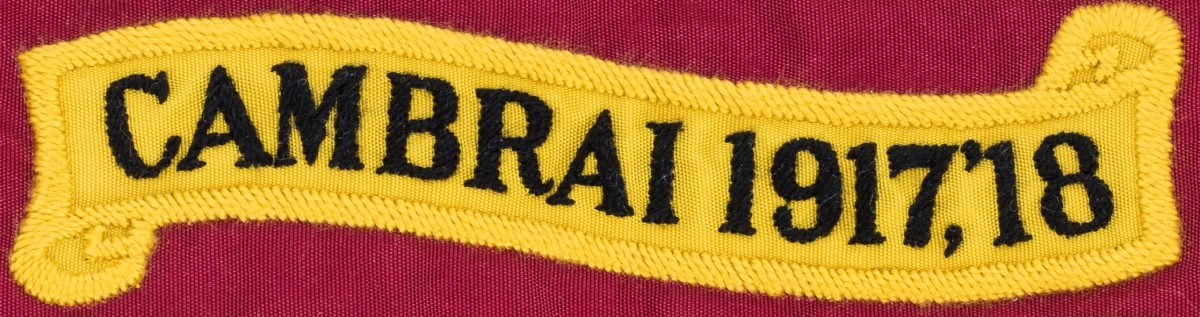
The Battle Honour CAMBRAI 1917,'18 is emblazoned on the King's Colour of The Royal Irish Regiment.
CAMBRAI 1917, the last of the three main battles of 1917, began at 0620 hours on 20 November 1917. It was an historic battle because the British used tanks en masse for the first time; some 381 tanks achieved surprise and gave great impetus to the infantry assault.
At 1030 hours on 23 November, the fourth day of the Battle of Cambrai, the 9th Battalion The Royal Irish Fusiliers again fought its way into Moeuvres where the Faughs beat off an immediate German counter-attack. The village was held until 1630 hours when the unsupported Faughs had to withdraw. The cost in casualties was 89 all ranks killed and wounded.
(Right, the 11th Inniskillings near Havrincourt (© IWM Q3174))
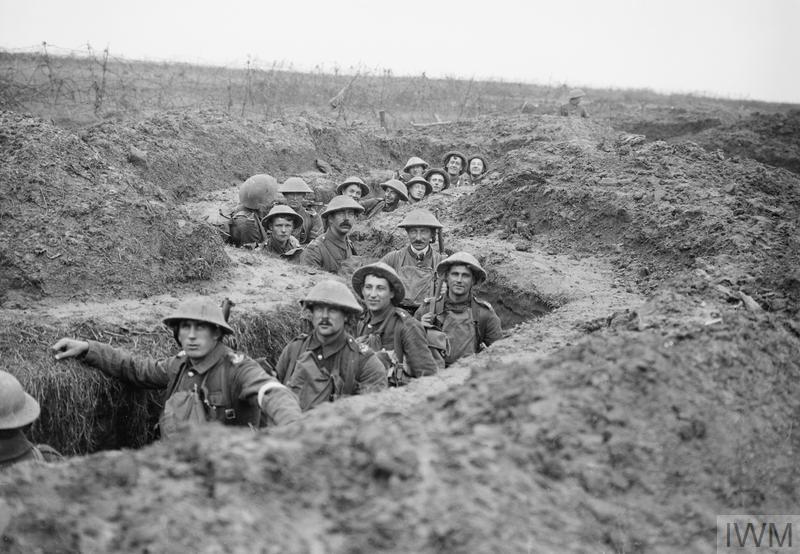 The attacks at Cambrai in November 1917 pressed forward again on 21 November, the second day of the Battle of Cambrai.
On the third day of the Battle of Cambrai, 108 Brigade including the 2nd, the 11th/13th and 12th Battalion The Royal Irish Rifles and the 9th Battalion The Royal Irish Fusiliers relieved 109 Brigade and continued the attack across the Bapaume – Cambrai road against the Hindenburg Line.
(Right, men of the 16th Battalion The Royal Irish Rifles (Divisional pioneer troops, 36th Ulster Division) moving forward along the Ribecourt road earlier on 20 November)
The Battle Honour CASSINO II is emblazoned on the King's Colour of the Royal Irish Regiment.
The story of our forebears' fighting at Cassino was related in The Blackthorn 2010 edition in an article written by the military historian, author and broadcaster Richard Doherty. The article below is reproduced with his permission.
The Battle Honour DJEBEL TANNGOUCHA is emblazoned on the King's Colour of The Royal Irish Regiment.
Towards the end of April 1943, the 78th Infantry Division prepared for the final offensive through the mountains to Tunis; but first it had to capture the heavily defended fortress mountain heights of Djebel Tanngoucha*. Initial attacks had failed. On the night of 22 April, 38 (Irish) Brigade, with massive artillery support, attacked Tanngoucha and the village of Heidous.
 The Battle Honour DUNKIRK 1940 is emblazoned on The King's Colour of The Royal Irish Regiment. The distinction was awarded to The Royal Ulster Rifles for the 2nd Battalion’s actions in holding ground and defending the perimeter of the embarkation area during the fighting from 26 May-3 June 1940, when over 338,000 personnel were evacuated from Dunkirk.