

Explore Listing
During the Battle of Arras 1917, the 1st Battalion The Royal Inniskilling Fusiliers returned to the front line on 14 May. The Inniskillings faced a German position known as 'Hook Trench' and received orders to take part in a local operation to attack the enemy position, including a copse at its north end.
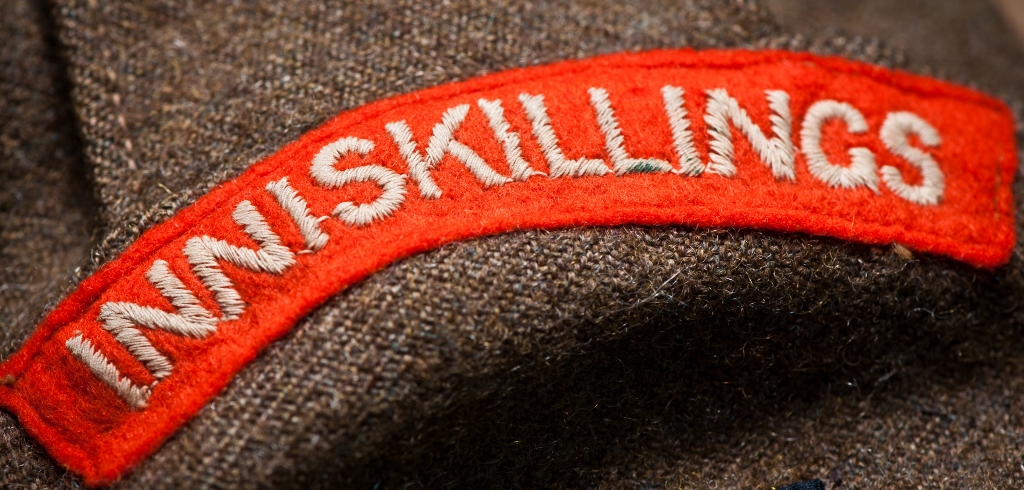 A Company of the 1st Battalion The Royal Inniskilling Fusiliers, on 1 January 1943, was given the task of attacking the village of Thayetpin in Burma, a village occupied by Burmese guerillas. A wide watercourse protected the village with mangrove bushes on either bank.
During the War of the Austrian Succession, King George II’s son, Prince William The Duke of Cumberland, was defeated at Fontenoy and following other setbacks in Flanders, the French encouraged Charles Edward ‘Bonnie Prince Charlie’ to lead a Jacobite revolt to take back the British crown for the Stuarts. He landed with a small band of his supporters on 25 July 1745 at Moidart in Inverness-shire.
The Duke of Wellington’s State Funeral.
The Duke of Wellington KG GCB GCH PC FRS, Field Marshal and Commander-in-Chief of Her Majesty‘s Forces, died on 14 September 1852 aged 83. The only Waterloo veteran still serving at this time was the surgeon, Dr Mostyn. However, it was the then commanding officer of the 27th Inniskillings, Lieutenant Colonel A A Cunynghame and a detachment consisting of Captain Tounzel, Lieutenant Manly, one sergeant, one corporal and six privates, who represented the Inniskillings at the great pageant of Wellington’s Heraldic State Funeral in London on 18 November 1852. It was estimated that over one million spectators lined the route to watch the two-mile long procession passing from Horse Guards to St Paul‘s.
In 1788, the Inniskillings landed in Ireland and spent the next three years on duties in Limerick and in Dublin. The following extract from a Dublin paper, dated 25 February 1788, gives an idea of some of the peacetime duties soldiers were called upon to perform:
During the night of 6 August 1915, the 1st Battalion The Royal Inniskilling Fusiliers was tasked to undertake deception actions in support of attacks against Turkish positions.
During that night, planks were placed across trenches and at 0400 hours A and D Company withdrew into ravines where they spread out sheets and dragged them around in order to attract enemy artillery that came over at 0530 hours. At 0900 hours they also created clouds of dust along a mule track by dragging brushwood and blankets on a rope to represent strong reinforcements arriving.
At the end of November 1830, the 27th Inniskilling Regiment, having completed seven years of service in the West Indies, embarked at Barbados in three ships; their destination was Cork. The years in the tropics had taken many lives. The graveyards in the various Colonies where the Regiment had been quartered - Demerara, Berbice, St Vincent, Grenada and Barbados - contained the remains of 302 Inniskillings.
The 2nd Battalion 27th Regiment of Foot (Inniskillings) had been recruiting in Scotland in 1805 and had been joined by detachments from the 'army of reserve', the Irish Militia, the Scotch Militia and some 60 recruits from Belfast. The 2/27th was in Edinburgh Castle on 21 October 1805, when it was ordered to proceed on active service. With a full complement of officers and 612 rank and file they embarked for Gravesend, which was the rendezvous point for the troops selected for an expedition to Northern Germany.
Retreat to Dunkirk
The Battle Honour YPRES-COMINES CANAL was awarded to the Royal Inniskilling Fusiliers for actions there by the 2nd Battalion during the British Expeditionary Force's withdrawal to Dunkirk. However, after the Second World War the Regiment did not select the distinction to be emblazoned on The Queen's Colours.
Orders were issued, to take effect on 1 October 1771, for the formation of a light company of Inniskillings. The Regiment then consisted of ten companies, mustering twenty sergeants, thirty corporals, ten drummers, two fifers and three hundred and eighty privates.
Very particular instructions were issued with regard to the discipline and drill of these newly-formed light companies, and are interesting for comparison with the rules made for Rogers' Rangers*, as they both illustrate the tactical ideas of the day.
*