

Explore Listing
Commonly referred to as the Boer War, it was fought from 11 October 1899 - 31 May 1902 and concluded with the Treaty of Vereeniging, signed on 31 May 1902.
The Second Battle of Cassino was fought by the recently formed New Zealand Corps under command of General Mark Clark's US Fifth Army. Commanded by General Sir Bernard Freyburg, the Corps consisted of the 4th Indian Division and the 2nd New Zealand Division.
The war, as in the First Matabele War, was fought against the Ndebele and the Shona people. In December/January 1895/96, Cecil Rhodes engineered an armed invasion of the Boers' South African Republic. A force of some 500 mounted men was led by Dr Jameson and Rhodes also sent the British South Africa Police from Matabeleland. In the absence of this paramilitary police force, the Ndebele seized the opportunity to rise in revolt against the white settlers. The war is described in modern Zimbabwe as the First War of Independence.
The Second Sino-Japanese War was fought by the Republic of China and the Empire of Japan. Since 1915, the Japanese, intent on expanding their empire to secure economic resources and reserves, had fought a series of so-called ‘incidents’ (including the invasion of Manchuria) before total war broke out on 7 July 1937. When the Japanese attacked Pearl Harbour on 7 December 1941 the Second Sino-Japanese war merged with the Second World War and became part of the Pacific War fought by the Allied Powers against the Empire of Japan.
The city of Seoul is overrun and captured by Communist Chinese and North Korean forces.
Sergeant Jonathan Mathews of the 1st Battalion The Royal Irish Regiment Battlegroup was killed in action while on duty in the Marjah District of Helmand Province, Afghanistan.
The Axis forces in Tunisia, North Africa, were caught between the First Army and the Eighth Army. The First Army with 38 (Irish) Brigade had seized and were holding an area facing the Germans on the southern outer defence of Tunis.
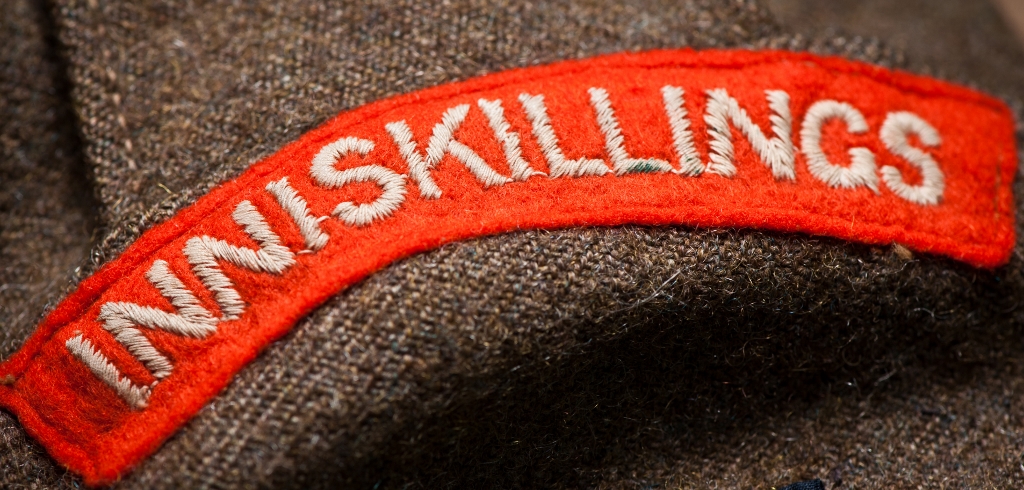
The 6th Battalion The Royal Inniskilling Fusiliers maintained a programme of vigorous patrolling activities against the enemy. Occasionally 'one-man' patrols occurred.
On 8 January 1812, Wellington began to advance through Spain. The turning point of the war had been reached. After a long march southwards over the mountains his army arrived at Badajoz and on St Patrick’s Day the siege operations began under appalling conditions of heavy rain. The rain turned the earthworks into slime and slush and necessitated the extensive use of sand-bags for the construction of breastworks and parapets. After five days of digging chores the siege batteries were installed.
The main conflict occurred during the seven-year period 1756–1763. Most of the great powers of Europe were involved and the conflict ranged across Europe, North America, Central America, South America, Africa and Asia. The two major belligerents were the British and the French. The war is also known as the French and Indian War in the United States and Canada and in French-speaking Canada, the ‘War of the Conquest’. The term ‘Seven Years' War’ is also used by many English-speaking Canadians.