

Explore Listing
The retreat from Mons had been going on for some days and the 2nd Battalion The Royal Irish Rifles, with the rest of the British Expeditionary Force, had been retreating. When the Rifles reached Crécy on 5 September, it was announced that the retreat had ended. During this fighting withdrawal, the Battalion had marched one hundred and forty miles over a period of twelve days.
The 6th Battalion The Royal Irish Rifles had disembarked at Anzac Cove, Gallipoli during the night 5/6 August 1915. On 7/8 August, General Godley's II Anzac Corps tried to capture the hill Chunuk Bair and when the attack did not succeed, 6 RIR was moved forward to the Sari Bair Plateau with the 10th Hampshires leading.
The 83rd (County of Dublin) Regiment had moved from Aldershot in April 1865 and was split between two locations; one was Sheffield and the other Weedon. In addition to garrison duties, the 83rd was also deployed to deal with electoral rioting in Nottingham, Grantham, Lincoln and Rotherham during June and July 1865. On 21 July, the authorities in Rotherham telegraphed requesting military assistance to assist the police in quelling one such riot.
Set against the background of a changing political situation in Ireland, the War Office took the decision to retitle The Royal Irish Rifles and create a provincial regiment for Ulster as already enjoyed by Munster, Leinster and Connaught. The Regiment's title was changed to The Royal Ulster Rifles. Naturally, this caused much despondency at first, but gradually was accepted.


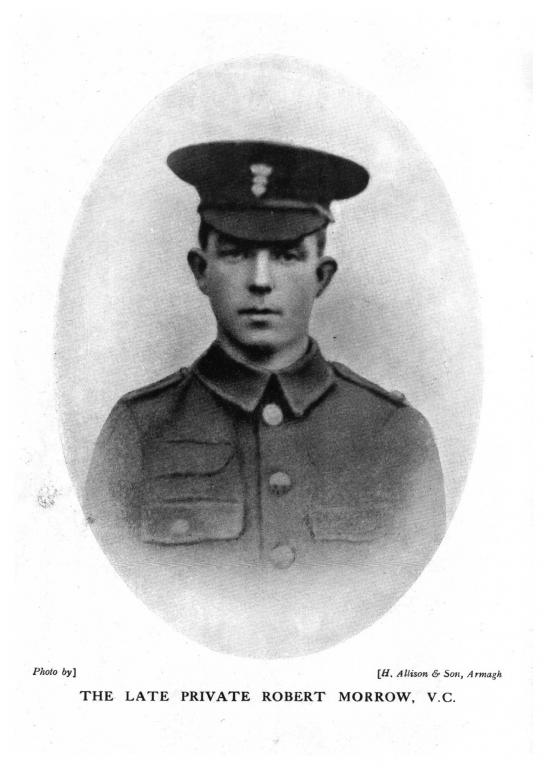 Robert Morrow, born and raised on a farm near Newmills, Dungannon, was the son of Hugh and Margaret Jane Morrow. Robert joined The Royal Irish Fusiliers at Armagh in 1911 and after basic training went to England with the 1st Battalion.

 Robert Quigg was born in 1885 at Cornkirk, County Antrim near the Giant’s Causeway where, as a young man, he worked on the Macnaghten's estate. When Sir Edward Harry Macnaghten, aged 20, served with the 12th Battalion The Royal Irish Rifles as a Rifle Platoon Commander, Robert Quigg became his batman.
The Secretary of State for War, Hugh Childers, restructured the infantry of the British Army in what was known as the Childers reforms of 1881. The 102 Regiment of Foot (Royal Madras Fusiliers) and The 103rd Regiment of Foot (Royal Bombay Fusiliers) were given Irish territorial titles under the restructuring and designated the 1st and 2nd battalions The Royal Dublin Fusiliers. The Home Depot was established at Naas, County Kildare and the Regiment also provided three Militia (reserve) battalions
The commemorative item (right) was presented to The Royal Irish Regiment by The Royal Gibraltar Regiment on 3 July 1999.
The piece representing a hollowed-out log with sterling silver caps at either end, one bearing the cap badge of The Royal Irish Regiment, the other the cap badge of The Royal Gibraltar Regiment, was commissioned to mark Royal approval for a formal alliance between the two Regiments. The scroll detailing the alliance is held in the hollowed-out centre of the log that rests on a marble pedestal.
During the First World War, The Royal Inniskilling Fusiliers grew to a maximum of 13 battalions. This included the 3rd, the 4th and the 12th (Reserve) Battalion, mobilised in Ireland, that had kept the Regular and Service Battalions supplied with drafts of trained recruits.