

Explore Listing
At 0010 hours on 14 April 1951, when the 1st Battalion The Royal Ulster Rifles was occupying Hill 194 on the northern bank of the River Imjin in Korea, an enemy patrol set off a trip flare in the rear of D Company's position. In the light of the flare, 12 Platoon saw several enemy whom it engaged promptly. A close range grenade battle began as a number of Chinese attacked the platoon position. Several Chinese took possession of a communication trench, but they were soon dislodged, albeit with some difficulty.
The first part of the Chinese Spring Offensive was launched against the United Nations' Command's (UNC) Eighth Army, with the UNC engaged in fierce fighting in the Battle of the Imjin River and the Battle of Kapyong in the west. The battles in these sectors from 22–25 April 1951 absorbed the Chinese attempts to break through the UNC until it was halted along what was known as the 'No-name Line' north of Seoul.
As X Corps of the United Nations Command (UNC) began its landings at Wonsan, the Chinese had already, on 13/14 October crossed the border on the Yalu River, followed four days later by their commander, General Peng Dehuai.
Fourth Phase (Defensive) Campaign, Korea; 30 January – 21 April 1951.
The tempo of operations in Korea for the Chinese People’s Volunteer Army (PVA) forced their commander, General Peng, to cease fighting so that his forces could recover over what should have been a necessary and extensive period, but the United Nations Command (UNC) resumed an offensive before he could recouperate and refurbish.
The United Nations Command (UNC) had failed to detect the very large number of Chinese PVA formations that had crossed into North Korea. When, on 24 November 1950, the UNC had launched the Eighth Army in the west and its X Corps in the east, on what was known as the 'Home-by-Christmas' offensive, it believed that the UNC forces outnumbered the enemy forces.
Following the end of the Second Phase Offensive, the Chinese People's Volunteer Army (PVA) was ordered to attack the United Nations Command (UNC) forces around the 38th parallel on 31 December 1950. When they did so, they destroyed a number of South Korean divisions and began breaking through the UNC defensive line. Chairman Mao's aim in ordering the Third Offensive was to force the will of the United Nations and the US President into abandoning South Korea and withdrawing from the Korean peninsula.
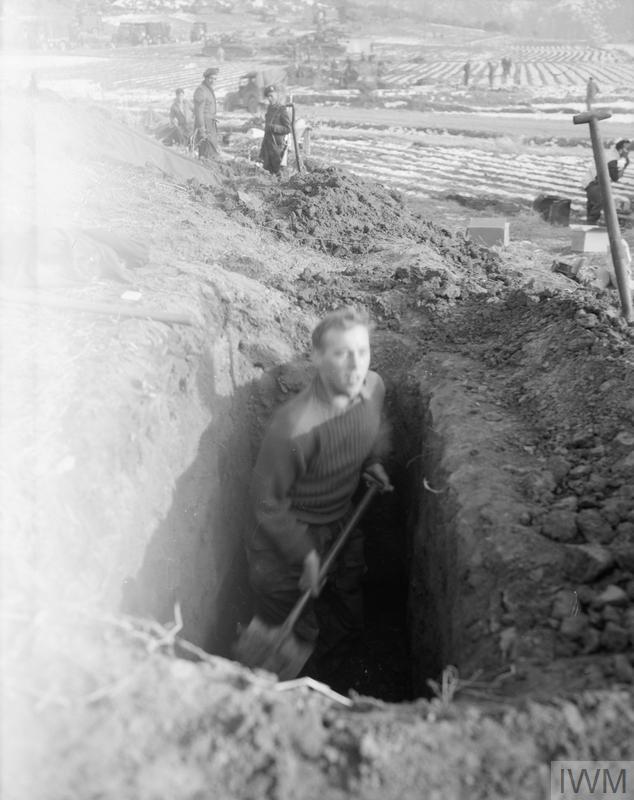
Left: Men of the 1st Battalion The Royal Ulster Rifles dig deep defensive positions in Korea. These later had to be abandoned when United Nations Command (UNC) forces withdrew in the face of the Chinese People's Volunteer Army (PVA) Second Phase Offensive (© IWM (BF 224)).
The 1st Battalion The Royal Irish Rifles was in trenches near Fauquissart, France when, at around 2000 hours on Christmas Eve, the Germans in the trenches opposite raised lanterns above their parapet and called out:
‘Do not shoot after twelve o'clock, and we will not do so either.’
Later, one Riflemen ventured across no man’s land and was not fired on. He was given a cigar and then told to return to his lines. Following that, a German officer appeared and asked for a two-day truce; the Commanding Officer's response was ‘Only one day’.

After the Battle of Colenso on 15 December 1899, the 1st Battalion The Royal Inniskilling Fusiliers withdrew to Frere where they remained until 10 January 1900. Although they were on active service and despite having suffered a recent defeat, a period of inactivity followed for General Sir Redvers Buller's army. The Inniskillings therefore prepared for Christmas. A newspaper correspondent described the camp as having 'the appearance and spirit of a fair'.
This box was made to commemorate the victory of the 87th Foot over the French at the Battle of Barrosa on 5 March 1811.
The plain wooden box is decorated with the most significant regimental symbols fashioned in Irish silver. The Eagle represents the Eagle captured from the French 8th Demi Brigade at the Battle of Barrosa. This was the first Eagle standard captured from the French in the Peninsula War against Napoleon.