

Explore Listing
 Captain Eric Norman Frankland Bell VC was born on 28 August 1895 at Alma Terrace in Enniskillen, the son of Edward and Dora Bell. At the time, his father was Quartermaster to the 2nd Battalion The Royal Inniskilling Fusiliers. His mother came from Manorhamilton, County Leitrim and his father from Budeaux, Devon.
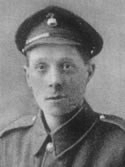 Ernest Seaman was born near Norwich, Norfolk on 16 August 1893. He had enlisted into the Army Service Corps as a baker, later transferring to The Royal Inniskilling Fusiliers when he was medically certified as fit for duty with, for example, an infantry battalion in the front line. He was a 25 year-old Lance Corporal with the 2nd Battalion The Royal Inniskilling Fusiliers when he was awarded the Victoria Cross for his actions at Terhand, Belgium on 29 September 1918.
Ewing Henry Wrigley Grimshaw (Harry) was born on 30 June 1911 in India, where his father was serving with the 1st Punjab Regiment. He was appointed Colonel of The Royal Inniskilling Fusiliers in 1966 in succession to Major General Denis Moore and he held the appointment until 1968 when he was appointed as a Deputy Colonel of The Royal Irish Rangers.
Ex KILGORE FINN was a 4th Battalion The Royal Irish Regiment trekking expedition to Vietnam from 13 February – 10 March 2001. The outline plan was to fly into Hanoi and then move to Sapa as an administrative base for trekking the surrounding Hoang Lien Mountains. The expedition first conducted a challenging ascent of Mount Fansipan, which, at 3143 meters, represents the highest peak in Indochina. This was immediately followed by an eight day trek to the ethnic minority 'Montagnard' villages in the Sapa region.
 After the German advance had closed up to Leuven (Louvain) on 14 May 1940, the 2nd Battalion The Royal Ulster Rifles were in continuous contact with the enemy for the next two days. Despite attempts to cross the canal, the Battalion kept the enemy from capturing the town.
After three days of fighting, 9-12 April 1917, in the area of Fampoux and Arras, there was a lull in the battle. For much of the remainder of April, the 1st Battalion The Royal Irish Fusiliers were either in reserve or resting to the rear of the battle zone.
In 1807, during the Napoleonic Wars with France and its ally (at that time) Spain, the 1/87th Regiment was part of the Expeditionary Force, commanded by Lieutenant General Whitelock, that attempted to capture Buenos Aires. The British aim was to control the region of the River Plate, an area dominating the South Atlantic where the trade winds were important for passage around Southern Africa. Buenos Aires was the capital of the Spanish Viceroyalty of the Río de la Plata.
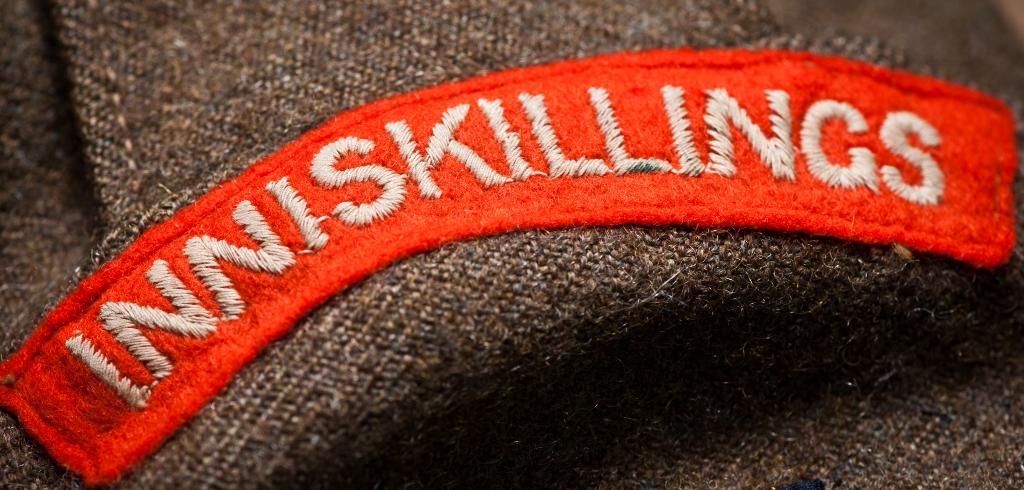 The following is the text from Army Form W.3121 describing the date, place and action for which P/No 194859 Lieutanant Basil Creyke Fairweather was recommended for an award by the Commanding Officer of the 1st Battalion The Royal Inniskilling Fusiliers, Lieutenant Colonel J R C Crosslé on 28 Februay 1943 and forwarded through the chain of command for approval.
This small booklet of psalms and hymns for soldiers in the field was one of many produced in the First World War. Most soldiers in the British Army at that time had a strong Christian faith and chaplains of all denominations were attached to all divisions and units. Proper church services were held when circumstances allowed and services were held "in the field” when war activities took precedence.
The Falklands Conflict, 2 April to 14 June 1982, followed the invasion of the Falkland Islands by Argentina on 2 April 1982. Although war was never formally declared, the brief conflict, in which a joint British Task Force was dispatched at very short notice to recapture the Islands, saw nearly 1,000 lives lost and many more wounded.