

Explore Listing
The following is an account of an event that took place after Waterloo when Wellington’s Army was garrisoned as the Army of Occupation in France.
In common with the Colonel of the Tyrone Militia, the Honourable William Conyngham, Colonel of the Donegal Militia, sought royal patronage for his command when it was raised in April 1793. Conyngham’s request was successful and the regiment was embodied by 23 August 1793 as the Prince of Wales’s Donegal Regiment of Militia. However, there were only 216 rank and file rather than the 560 authorised.
A Mace carried by the Drum Major of the North Irish Band, the band which supported the Territorial Battalions of the North Irish Brigade and The Royal Irish Rangers. The Cap Badge fixed on the Mace is that of The Royal Irish Rangers.
 An Army Form W.3121, Recommendation for Award, was raised by the Commander 9 Infantry Brigade on No 44776 (T/Maj) A/Lt.Col John Drummond RUR, commanding the 2nd Battalion The Royal Ulster Rifles, and submitted to the chain of command through 3rd British Infantry Division, XXX Corps, Second Army and eventually signed by the Commander-in-Chief 21 Army Group, Field Marshal Montgomery.
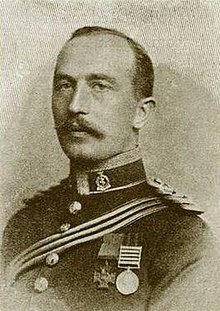 Edgar Inkson was born 5 April 1872, at Naini Tal, India, the son of Surgeon General J Inkson, Army Medical Service.
Edmund, son of Arthur and Margaret Jane De Wind, was born in Comber, Co Down, Ireland on 11 December 1883. He attended Campbell College before working for the Bank of Ireland and later emigrated to Canada. He was working for the Canadian Bank of Commerce in Edmonton when he enlisted into the 31st Battalion (Alberta), Canadian Expeditionary Force (CEF) on 16 November 1914. He fought with the CEF at St Eloi, Ypres and the Somme. He was discharged as a Private on 23 September, following officer cadet training in England, and commissioned into The Royal Irish Rifles on 26 September 1917.
Eric Moore was born on 24 September 1894. He was commissioned into the Royal Inniskilling Fusiliers from the Royal Military College, Sandhurst in 1914, when he was posted to the 2nd Battalion. He remained with the Battalion until wounded during the Battle of Festubert in May 1915, after which he was invalided home. He was appointed Adjutant of the 4th (Reserve) Battalion at Buncrana, and was rushed to Dublin with the Ulster Composite Battalion to deal with the Easter Rising in 1916.
Returning to France in 1918, he was taken prisoner during the big German offensive of that year.
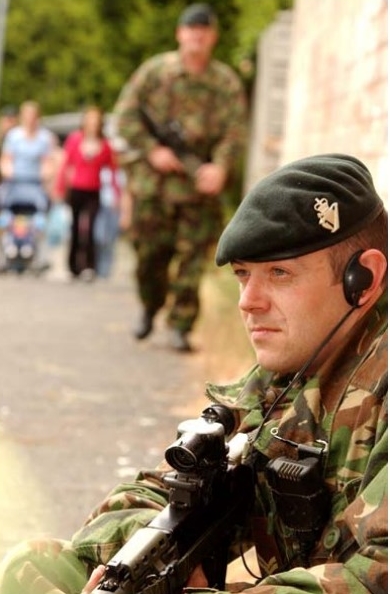 The support by the United Kingdom's Armed Forces for the Police Service Northern Ireland, known as Operation BANNER, ceased at midnight on 31 July 2007. At the peak of the campaign in the summer of 1972, 28,000 soldiers were deployed.
At 1932 hours on the evening of 25 December 1991, the flag of the Soviet Union was lowered from the Kremlin and replaced with the national flag of Russia. It was also the day that the USSR's eighth and last president, Mikhail Gorbachev, resigned, declared his office defunct and handed over power to a Russian President - Boris Yeltsin.
The Provisional IRA attacked the Remembrance Sunday service in Enniskillen by exploding a bomb near the Cenotaph just prior to proceedings. Eleven people were killed and more than sixty injured. A twelfth person would later die after spending twelve years in a coma. Soldiers of the 4th (Co Fermanagh) Battalion The Ulster Defence Regiment provided immediate first aid and were instrumental in saving many lives. Soon after the attack the Battalion took part in a major operation, mounting foot, mobile and heliborne patrols throughout the Fermanagh area.