

Explore Listing
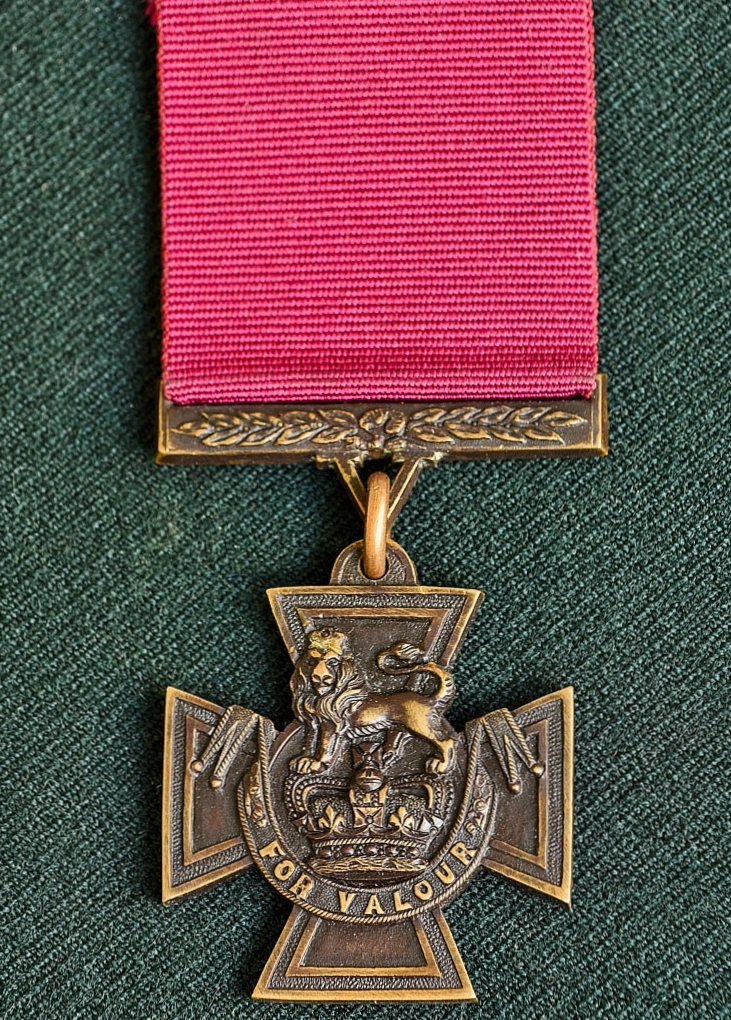
As an officer in the 9th Battalion The Royal Irish Fusiliers, Lieutenant Geoffrey Cather was awarded the Victoria Cross for his actions on 1 July 1916, the first day of the Battle of the Somme.
These boots were specially made to hold spurs (boxed) and were worn by British Army officers when in dress uniform.
To this day field officers, those of the rank of Major and above and the Adjutant of a Battalion, will wear spurs in boxed boots when in ceremonial or mess dress uniform. This dates back to an era when such officers would have been mounted on horseback where more junior officers would have commanded and fought on foot.
The spur on the left in the picture is, in fact, upside down and would not have fitted in the boot this way!
On 20 September 1939, the 1st Battalion The Royal Irish Fusiliers moved to Aldershot prior to its embarkation for France. In the meantime the unit was granted the privilege of a visit by the King and Queen, who during the course of the day inspected the Battalion on parade. This was the first occasion when Battle Dress was seen in public.
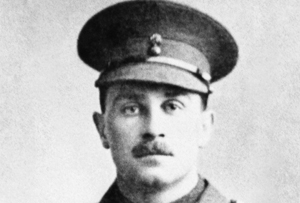 Gerald Robert O'Sullivan was born in Frankfield, Co Cork, Ireland on 8 November 1888. He was killed in action at Suvla, Gallipoli on 21 August 1915.
Just before the Second World War began on 3 September 1939, the 1st Battalion The Royal Irish Fusiliers was based in Guernsey. When orders forced a hurried move for the Battalion to England and then France, it was decided to leave the Regimental Silver in a bank vault in Guernsey. During the German occupation of the island many pieces of Regimental Silver were stolen and removed to Germany.
The German Lys offensive, Operation GEORGETTE, was a continuation of the German Spring Offensive, with its objective as the capture of Ypres and forcing the British back to the channel ports and out of the war. The German Fourth and the Eighth Army plan was to break through the British First Army, push the Second Army aside to the north, and then advance west to the English Channel, cutting off British forces in France from their supply line from through the Channel ports of Calais, Dunkirk and Boulogne.
A group of German Prisoners of War are marched through the streets of Bologna in 1945.
On 21 March 1918, the Germans launched a massive offensive in the Somme, between Arras and La Fère, against the British Third and Fifth Armies; included in the latter was the 36th (Ulster) Division. The German High Command had moved some fifty divisions from the eastern front, where the Russians had surrendered, to confront what they perceived as a weakened British Expeditionary Force (BEF).
The German's main 'Hitler' counter-offensive to dislodge the Allied landings was planned for 16 February 1944 on an axis astride the main route from Albano to Anzio. This route breaking through the beachhead's perimeter would be beyond the range of effective Allied naval-gunfire support, provide good going for German armoured formations and be supported by a reinforced Luftwaffe's expected local air superiority.
The Axis Operation MERCURY was the invasion of the island of Crete. Despite early setbacks following the iniitial parachute and glider landings, including a failed seaborne landing, further airborne landings, the eventual capture of Maleme Airfield in western Crete, and a seaborne landing, forced an Allied evacuation. Those not evacuated by the Royal Navy eventually surrendered and the few who evaded capture joined the local resistance.