

Explore Listing
The following is Brigadier Pat Scott's account of the 38 (Irish) Brigade's audience with His Holiness Pope Pius XII and the musical performance by the Pipes and Drums in St Peter's Square.
When the Irish Free State gained independence from British rule, it was to remain within the British Empire in accordance with the Anglo-Irish Treaty of 6 December 1921, the treaty that concluded the Irish War of Independence. The treaty described the new state as a self-governing dominion and allowed for a six-county region of the north to remain within the United Kingdom as Northern Ireland.
The Constitution of the Irish Free State (Saorstát Éireann) Bill was introduced into Dáil Éireann in September 1922, (the Dáil sitting as a 'Constituent Assembly') and was enacted on 25 October 1922. Article 83 of the Constitution provided that:
'The passing and adoption of this Constitution by the Constituent Assembly and the British Parliament shall be announced as soon as may be, and not later than the sixth day of December, Nineteen hundred and twenty-two, by Proclamation of His Majesty, and this Constitution shall come into operation on the issue of such Proclamation.'
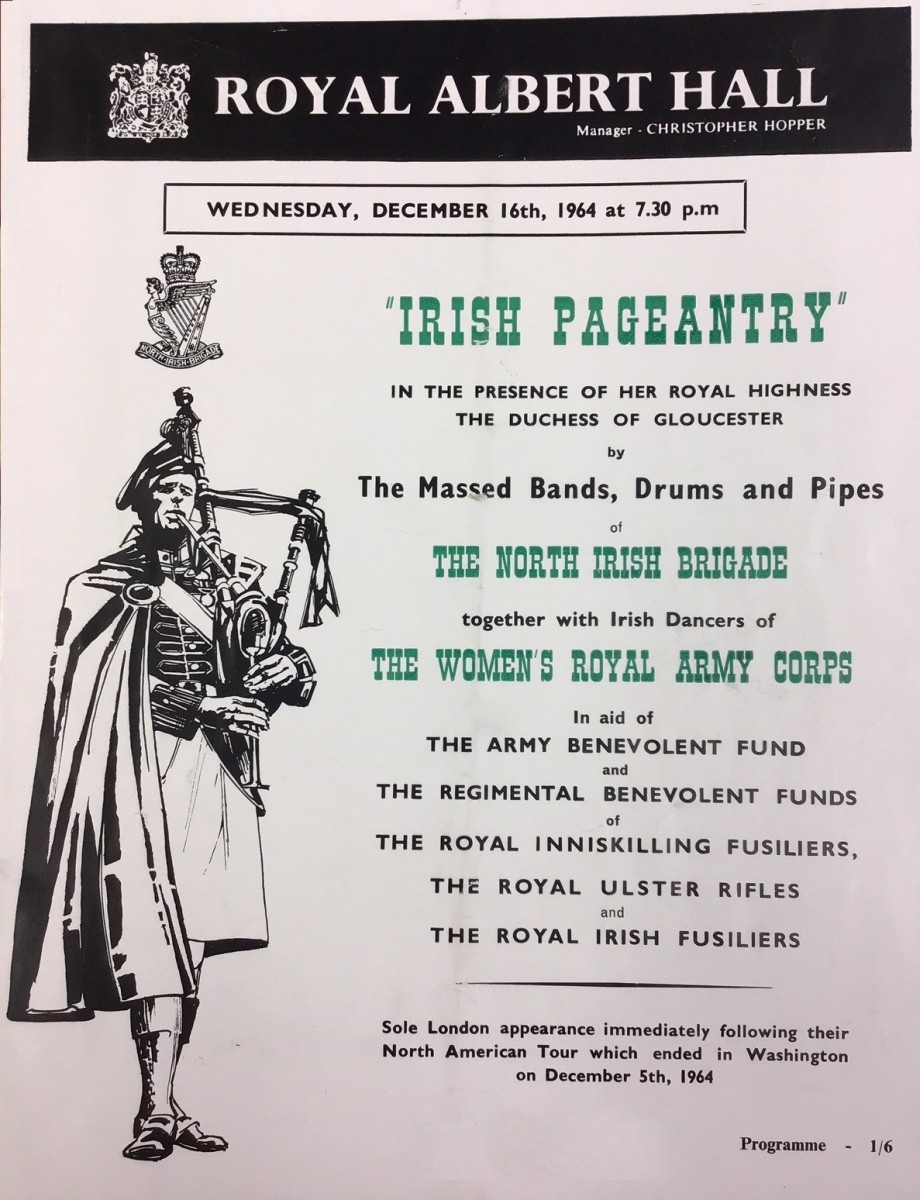
Following a tour of the United States, the Massed Band, Drums and Pipes of the North Irish Brigade performed at the Royal Albert hall in London with proceeds going to the Army Benevolent Fund and regimental benevolent funds of all three participating regiments. The advertising is below:
The secret armistice with the Allies was signed in Sicily on 3 September and announced by Eisenhower on 8 September. Hitler began the occupation of Italy with operation AXIS on 8 September and Italy then declared war on Germany on 13 October 1943.
The Jacobite rising of 1745 was the attempt by 'Bonnie Prince Charlie' (Charles Edward Stuart - the Young Pretender), to regain the British throne for the exiled House of Stuart. He landed on the isle of Eriskay, Scotland, on 23 July 1745. Following victory at Prestonpans his Jacobite army marched south to Carlisle in England. His army advanced as far as Derby before being forced to retreat north to Inverness. The last battle in Scotland was fought at Culloden where the Jacobites were defeated and Bonnie Prince Charlie fled with a bounty on his head, before finally sailing to France.
 One of the improvised weapons manufactured in the trenches in early 1915 was the Pipe Mortar modelled on cannons recent and ancient. The basic model was cut from a length of heavy gauge steel water or gas pipe and had a base plate welded onto one end. Adjustable legs were fitted to provide the required change of launch angle to achieve various ranges. A touch hole was drilled towards the base of the 'barrel'.
 (Left and lower right, the Victoria Cross awarded to Private Byrne ©)*
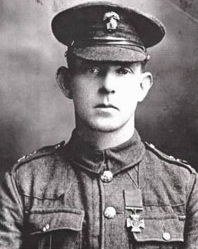 James Duffy was born on 17 November 1889 in Gweedore, County Donegal in Ireland. He was 28 years old and was a stretcher-bearer and a Private in the 6th Battalion The Royal Inniskilling Fusiliers when he was awarded the Victoria Cross (VC). On 27 December 1917 at Kereina Peak, Palestine, whilst the company was holding a very exposed position, Private Duffy went froward with another stretcher-bearer to bring in a seriously wounded comrade.
The following is an extract from the tribute written by Major General Corran Purdon that appeared in the 1995 - 1996 edition of 'Blackthorn, The Journal of The Royal Irish Regiment'.
James was born in Antrim, on 26 June 1921, to the Reverend Doctor Matthew Majury and his wife Florence, nee Stuart.