

Explore Listing
James Pearson was born in Rathdowney, Queens County*, Ireland on 2 October 1822. He died aged 77 in Madras, India on 23 January 1900. He was a Private in the 86th (Royal County Down) Regiment of Foot during the Indian Mutiny when he was awarded the Victoria Cross for his actions at the storming of the fort at Jhansi on 3 April 1858 and later at Calpee. The following notice, dated 28 April 1860, from the War Office appeared in the London Gazette published on 1 May 1860.
James Samuel Emerson was born on 3 August 1895 in the village of Collon, near Drogheda, in County Louth, Ireland. He enlisted into the 3rd Battalion The Royal Irish Rifles, a Reserve Battalion in Dublin, on 16 September 1914, and completed his training before sailing for France with the British Expeditionary Force on 16 April 1915. He served as a machine gunner and was promoted twice. As a Corporal he was wounded at Hooge on 29 September and evacuated to a hospital in the United Kingdom.
 James Somers was born in Belturbet, County Cavan on 12 June 1894. His family was living in Cloughjordan, Tipperary (in the Diocese of Killaloe), when he enlisted in The Royal Inniskilling Fusiliers in 1912 and was wounded during the British Expeditionary Force's retreat from Mons.
A state of war results from the surprise attack on the US Pacific Fleet anchored at Pearl Harbour, Honolulu, by the Empire of Japan. The Japanese declared war on that day, although not received by the US until the next day, 8 December, when Congress passed a declaration of war on Japan. President Franklin D. Roosevelt proclaimed the day ‘a date which will live in infamy’ as the US was a neutral state and attacked before the declaration of war was made.
This declaration of war began the assault on the German Navy base Tsingtao (Qingdao), China. This was the base for the German East Asia Squadron, which protected the German colonial territories in the Pacific region. The siege of Tsingtao was mounted by a joint British-Japanese force.
Most of the German East Asia Squadron was destroyed by the British at the Battle of the Falkland Islands on 8 December 1914, as they eventually attempted to return to Germany via Cape Horn and the South Atlantic.
An Instrument of Surrender was signed at Singapore on 12 September 1945 at 0341 hours (GMT) by Admiral Lord Louis Mountbatten, Supreme Allied Commander, South East Asia Command, and General Seishiro Itagaki, the Supreme Commander of the Japanese Expeditionary Forces Southern Region in South-East Asia.
A formal ceremony for the surrender of Japan had been conducted aboard the USS Missouri in Tokyo bay on 2 September 1945.
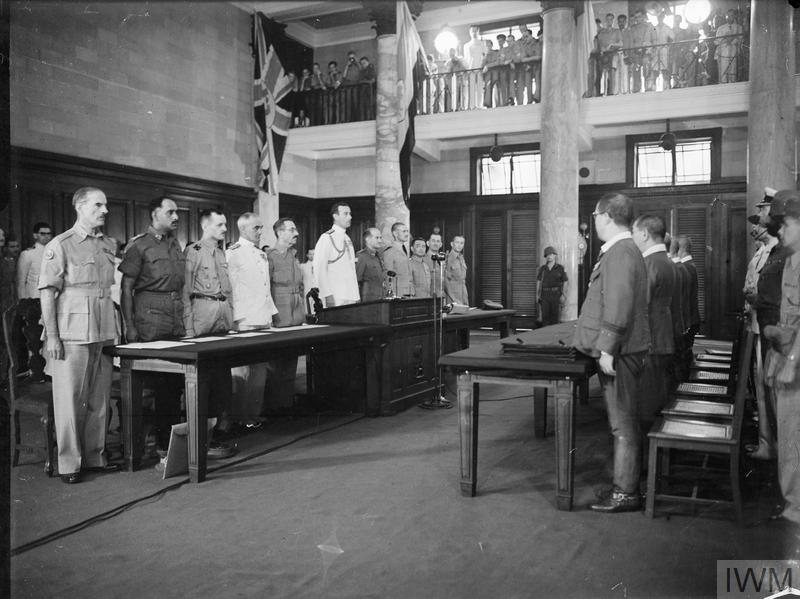
Above, the Allied delegation, led by Admiral Lord Louis Mountbatten, face the Japanese delegation led by General Itagaki across the table, for the signing of the surrender at Singapore.(Image - © IWM (A 30495)
On 20 December 1915, the 7th (Service) Battalion The Royal Irish Rifles, supplemented by 6 officers and 224 other ranks from the Jersey Militia, arrived in France. Lieutenant Colonel Stocker, previously the Commanding Officer of the Militia, remained as OC D Company in command of the Jerseymen. As nearly all of D Company spoke French, they were of immense value to the rest of the Battalion during their service in France. They also astonished the country folk when they sang French songs on the march.
On many occasions from the early 1800s the 86th Regiment were stationed in Jersey. Over the years a special relationship developed between the Regiment and the people of Jersey. Thus in 1914, when men from Jersey could not form a unit of their own, they asked to become part of the Royal Irish Rifles.
John Henry Coldwell-Horsfall DSO MC* was born on 21 February 1915 and died on 18 December 2006 aged 91. He was awarded the Military Cross (MC) in France in 1940, and a then a bar (*) to his MC in Tunisia in 1943, while serving with the Royal Irish Fusiliers; in 1944, by then commanding a battalion of the London Irish Rifles, he was awarded the Distinguished Service Order (DSO) at Cassino.